

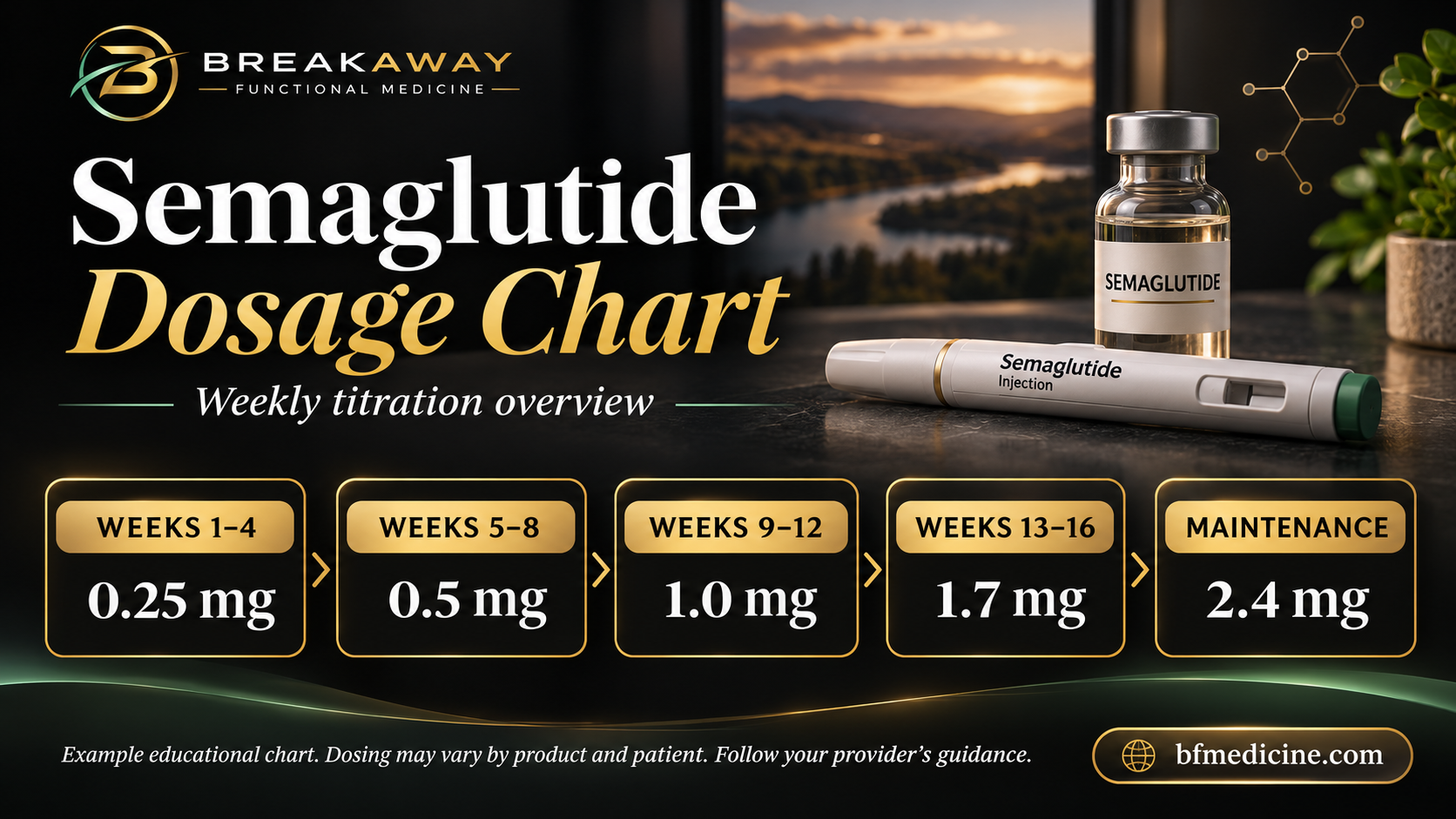
A semaglutide dosage chart shows how treatment starts and progresses. The correct schedule depends on the medication, formulation, treatment goal and how well you tolerate it.
Wegovy and Ozempic contain semaglutide, a glucagon-like peptide-1 receptor agonist. However, their approved uses and dosing instructions differ.
The charts below cover adult injections. They do not replace your prescription or apply to oral semaglutide tablets. Never start, increase or restart treatment using an online chart alone.
Wegovy Injection Dosage Chart
Wegovy supports weight management in eligible adults with obesity or overweight and a weight-related condition. The usual injection schedule progresses through four-week stages.
| Treatment period | Once-weekly dose | What this stage means |
|---|---|---|
| Weeks 1–4 | 0.25 mg | Starting treatment |
| Weeks 5–8 | 0.5 mg | Initial increase |
| Weeks 9–12 | 1 mg | Continued escalation |
| Weeks 13–16 | 1.7 mg | Further escalation |
| Week 17 onward | 2.4 mg recommended; 1.7 mg is another maintenance option | Ongoing adult weight management |
Your prescriber may delay escalation if you cannot tolerate a dose.
Current prescribing information also permits 7.2 mg weekly for selected adults who tolerate 2.4 mg for at least four weeks and need additional weight reduction. This requires a specific prescribing decision; it is not an automatic next step.
Ozempic Dosage Chart
Ozempic treats type 2 diabetes and has additional cardiovascular and kidney-related indications for specified patients. It is not FDA-approved specifically for weight loss.
| Treatment stage | Once-weekly dose | When it applies |
|---|---|---|
| First four weeks | 0.25 mg | Initiation |
| After four weeks | 0.5 mg | Ongoing treatment |
| After at least four weeks at 0.5 mg | 1 mg, if prescribed | Additional blood-glucose control |
| After at least four weeks at 1 mg | 2 mg, if prescribed | Additional blood-glucose control |
The maximum recommended Ozempic dose is 2 mg weekly. Higher doses are not necessary for everyone. Its kidney-risk-reduction indication specifies a 1 mg weekly maintenance dose after escalation.
Do not substitute one product’s schedule for another.
Why Does Semaglutide Increase Gradually?
Gradual dose escalation, called titration, helps reduce gastrointestinal side effects. A starting dose introduces treatment; a maintenance dose supports ongoing treatment goals.
Semaglutide affects appetite and satiety, helps regulate blood glucose, and slows gastric emptying. Responses vary, so a particular week does not guarantee stronger appetite suppression or a specific amount of weight loss.
Tell your provider about symptoms, changes in eating and treatment progress. Do not accelerate the schedule because the scale has stopped moving.
Semaglutide Milligrams, Milliliters and Syringe Units
Understanding medication measurements helps prevent dosing errors.
| Measurement | Meaning |
|---|---|
| Milligrams: mg | Amount of medication |
| Milliliters: mL | Volume of liquid |
| mg/mL | Concentration of medication in the liquid |
| Syringe units | Markings on the specified syringe |
There is no universal semaglutide syringe-units chart. The volume containing a prescribed dose depends on the product’s concentration and the syringe used.
Why Compounded Prescriptions Need Individual Instructions
Compounded semaglutide has no FDA-approved dosing schedule. A branded-product chart does not establish instructions for a compounded prescription.
Concentrations can differ between preparations. Follow the dispensing pharmacy’s instructions and ask your prescriber or pharmacist to demonstrate the correct measurement. Do not copy another patient’s instructions or calculate conversions yourself.
What Happens If You Miss a Dose?
Instructions depend on the product:
- Ozempic: Take the missed dose within five days. After five days, skip it and resume your regular schedule.
- Wegovy injection: Follow instructions based on the time remaining before your next dose. Ask your pharmacist if the timing is unclear.
Missing several doses is different from missing one. Contact your prescriber before restarting after an interruption; you may need a lower restart dose. Never double doses to catch up.
Side Effects and When to Contact Your Provider
Common side effects include nausea, vomiting, diarrhea, constipation and abdominal discomfort. Report symptoms that interfere with meals, hydration or daily activities.
Seek prompt assessment for severe or persistent abdominal pain, repeated vomiting or difficulty keeping fluids down. Breathing difficulty or swelling of the face or throat requires emergency care.
Your provider must also review other medications, pregnancy plans and relevant conditions. Semaglutide is contraindicated with a personal or family history of medullary thyroid carcinoma or MEN 2.
Medical Weight Management at Breakaway
Breakaway Functional Medicine offers medical weight management in Bismarck, including provider-guided GLP-1 treatment, nutrition guidance and progress monitoring.
Your assessment reviews your health history, lifestyle and goals. Follow-up appointments provide an opportunity to discuss tolerability, treatment response and changes to your plan.
For appropriate visits, telehealth services in North Dakota offer access to care remotely.
Frequently Asked Questions
Is semaglutide dosed according to body weight?
These injection schedules use fixed doses, not a simple milligram-per-pound calculation. Your provider assesses suitability and response.
Can I stay on a lower dose?
Discuss this with your prescriber. Appropriate maintenance treatment depends on the product, indication and tolerability.
Can I switch between tablets and injections?
Only with prescribing guidance. Oral and injectable doses are not equivalent milligram for milligram.
How can I support treatment?
Follow your nutrition and activity plan, maintain hydration, and attend follow-ups. Medication works alongside ongoing care.
Explore Breakaway’s weight-management program to discuss treatment suited to your needs.